
Quick summary: Learn how to remove PMI without refinancing, compare cancellation routes, calculate your equity target, and prepare a strong servicer request. Before you shop for a refinance, give your current mortgage a 20-minute review. If you have a conventional loan with private mortgage insurance, you may be able to remove PMI through your existing loan servicer—without replacing your mortgage, paying refinance closing costs, or giving up your current interest rate. The right route depends on what kind of mortgage insurance you have, your unpaid principal balance, the home’s accepted value, your payment history, and your servicer’s rules. An online home-value estimate alone will not cancel PMI, and reaching 20% equity does not always make the charge disappear automatically. Use this planning reset to identify your situation, choose the least expensive eligible path, and prepare a clean request for the coming week. Start with the line item on your mortgage statement F...
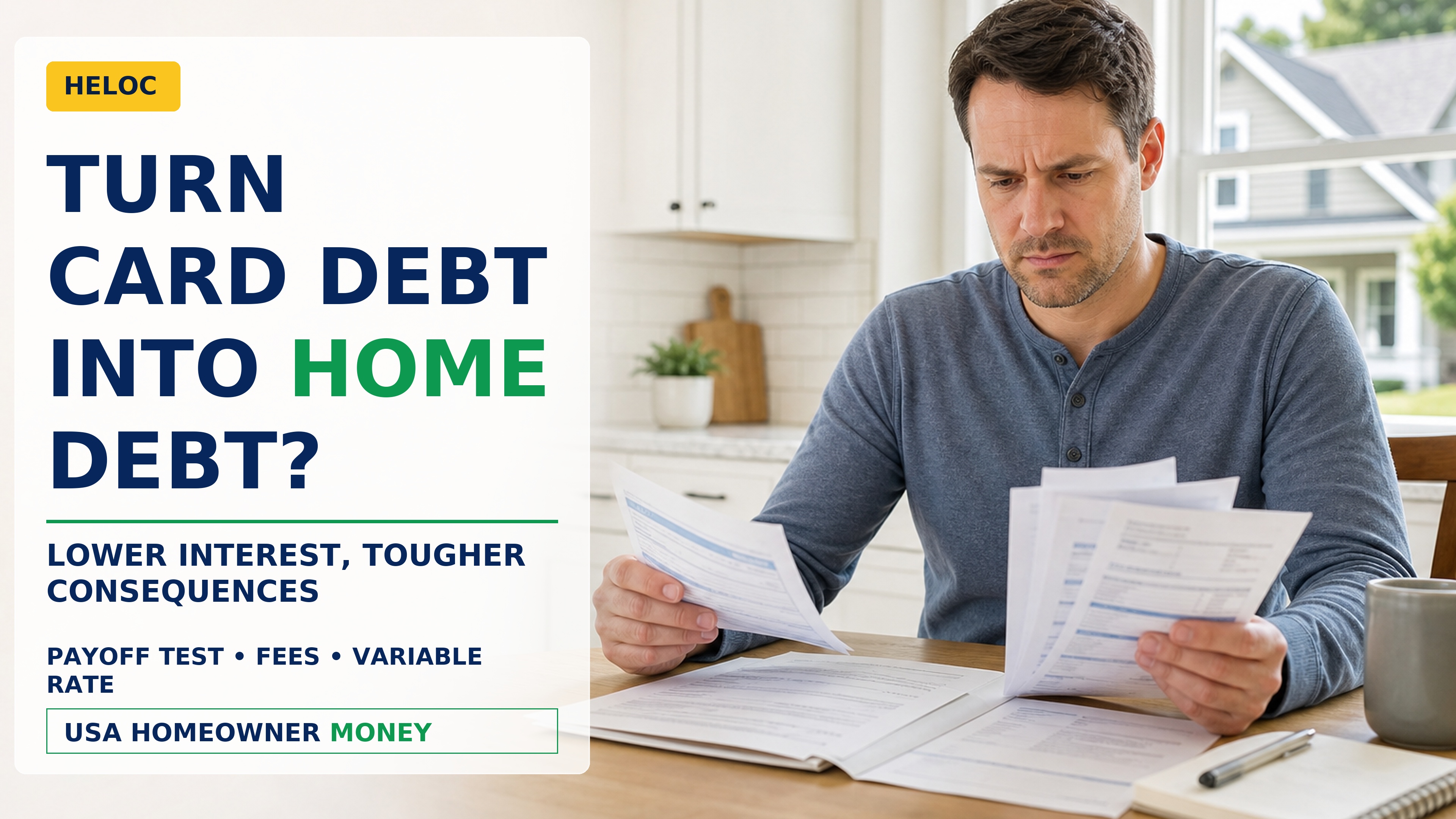
A HELOC can cut interest on credit card debt, but it converts unsecured balances into debt backed by your home. Consider it only if the cards have stopped growing, a fixed payoff payment survives a rate increase, and verified savings remain after every fee.
The lender’s minimum payment is not the right benchmark. Compare complete payoff plans: the dollars paid through a chosen payoff date, the payment structure, the consequences of default, and whether the household can continue the plan after an expensive surprise.
The criteria that should decide the question
Apply the same five tests to a HELOC, balance-transfer card, personal loan, home equity loan, or repayment program. There is no useful score based only on APR because a lower projected cost does not cancel the risk of attaching a lien to the house.
- Collateral exposure: Does the option put the home behind debt that is currently unsecured?
- All-in cost: What are the projected interest and fees through the same payoff date?
- Payoff certainty: Does the required payment steadily reduce principal, or can a low minimum let the balance linger?
- Payment resilience: Can the household maintain the plan after a rate increase, income interruption, insurance deductible, or major repair?
- Recurrence risk: Has the cause of the card debt ended, and what will prevent the cards from filling up again?
Use those criteria in order rather than averaging them together. First, reject any plan that depends on continued card borrowing for ordinary bills. Next, decide whether the projected savings justify collateral risk. Only then compare payment structure and flexibility.
This ordering changes the answer for different households. A stable homeowner with debt from a completed setback may reasonably accept home exposure for large net savings. A homeowner with an ongoing monthly deficit should not make the house security for yesterday’s expenses while new card balances continue to appear.
Compare payoff payments, not advertised minimums
A HELOC does not erase credit card debt. It changes the creditor, rate formula, payment rules, and consequences of nonpayment.
Consider a hypothetical $28,600 balance repaid with 48 equal monthly payments. Each calculation holds the stated annual rate constant for all four years. These figures illustrate the method; they are not current offers or predictions of future HELOC rates.
Swipe sideways to view every column.
| Payoff route | Monthly payment | Total interest | Security |
|---|---|---|---|
| Card at 24.49% | $940 | $16,528 | Unsecured |
| HELOC at 9.25% | $715 | $5,725 | Home |
| HELOC at 11.25% | $743 | $7,048 | Home |
Hypothetical amortization of $28,600 over 48 months, rounded to the nearest dollar. Figures exclude fees, new borrowing, late charges, and tax effects.
At 9.25%, the modeled interest savings are about $10,803 before HELOC costs. At 11.25%, the modeled savings are about $9,481. The calculation favors the HELOC on cost, but only if the borrower makes the principal-reducing payment for all 48 months.
An interest-only payment on $28,600 at 9.25% would initially be about $220 a month while the balance and rate stayed unchanged. That payment is easier to fit into a budget, but it does not reduce the $28,600 principal. Four years later, the borrower could still owe the original balance.
Choose the payoff date first. If the household can manage $220 but not $715, the HELOC has not made the debt affordable; it has deferred principal repayment and added the home to the contract.
Scenario: a completed setback with a four-year exit
Suppose the balance arose during a six-month unemployment period that has ended. The homeowner is working again, current income covers normal expenses, and no new card charges have been needed for three months. After preserving an emergency reserve and accounting for quoted HELOC fees, the household can commit $760 each month.
Under the stated criteria, a HELOC could be defensible. The cause of the debt has stopped, the available payment exceeds the amount modeled at both test rates, and the line would be used for a defined payoff. The household would still be accepting variable-rate and foreclosure risk, so a competing unsecured loan should be priced before proceeding.
Now change one fact: the household still needs $500 of card credit each month for groceries, utilities, and medical bills. The HELOC fails the recurrence test even if its rate is attractive. It would secure the old debt while new unsecured debt accumulates.
Stress-test the payment before pledging the house
Start with money available from ordinary monthly income. Do not rely on an expected tax refund, a discretionary bonus, overtime that may disappear, or unused credit from another account.
Calculate the payment at the offered rate and run it again two percentage points higher. That two-point increase is a planning assumption, not a rate forecast. It simply shows whether the budget has room for a variable-rate loan to become more expensive.
Include the first mortgage, property taxes, homeowners insurance, transportation, child care, medical expenses, and a realistic repair allowance. Lender approval means the application met that lender’s underwriting requirements. It does not establish that the payment is safe for the household.
Do not empty the emergency fund to make the plan work
Using most available cash to open the HELOC creates an obvious failure point. A transmission repair or insurance deductible arrives, checking cannot cover it, and the cleared cards return to service.
A durable plan preserves accessible cash while making the scheduled principal payment. If the budget cannot support both, compare a lower-risk option or address the cash-flow shortfall before consolidating.
Read the HELOC contract in dollars and dates
The Consumer Financial Protection Bureau explains that HELOCs generally have a draw period followed by a repayment period and usually carry variable rates. Payments can change as the rate changes. They may also rise substantially when the draw period ends, and some agreements can require the outstanding balance to be paid at once.
Pull these terms out of each disclosure before comparing offers:
- Rate formula: Record the index, lender margin, adjustment frequency, rate floor, and maximum rate.
- Promotional rate: If the opening rate is temporary, run the payoff using the later formula as well.
- Minimum payment: Determine whether it covers interest only or reduces principal during the draw period.
- Repayment dates: Note when borrowing ends, how long repayment lasts, and whether a balloon payment is possible.
- Fixed-rate conversion: Check eligible balances, the conversion rate, payment term, and fee.
- Account costs: Add applicable application, appraisal, title, origination, annual, inactivity, conversion, transaction, and early-cancellation charges.
CFPB guidance lists several fees that may apply, depending on the plan. A line advertised with limited or waived opening costs may still carry annual, inactivity, conversion, or early-cancellation charges. Those costs are especially relevant when the borrower intends to repay and close the line quickly.
A HELOC is revolving credit, so principal payments may restore available borrowing capacity during the draw period. That flexibility helps homeowners who expect several expenses over time. For a one-time card payoff, it may instead preserve the temptation to borrow again.
The federal cancellation window is short
When a HELOC is secured by the borrower’s principal dwelling, federal rules generally provide three business days to cancel after the account is opened or the required account-opening disclosures are received, whichever occurs later. CFPB guidance says the lender must be notified in writing. Follow the agreement’s delivery instructions and retain proof that the notice was sent on time.
Equity does not prove that the payment is affordable
Suppose a home is valued at $410,000, the first mortgage balance is $276,000, and the proposed HELOC draw is $28,600. Total debt secured by the property would be $304,600, producing a hypothetical combined loan-to-value ratio of about 74.3%.
That ratio describes leverage against the property. It does not show whether the homeowner has $715 available each month or could keep paying after a layoff.
The CFPB also notes that a lender may restrict additional HELOC borrowing after a significant decline in the home’s value or a material deterioration in the borrower’s financial circumstances. An unused line is therefore a poor substitute for cash savings.
A sale creates another constraint. A HELOC generally must be paid off when the home is sold, reducing the proceeds available for moving costs or the next purchase.
Do not add an assumed tax deduction
As of September 5, 2026, IRS guidance states that interest on home equity debt used for personal living expenses, including credit card debt, is not deductible as home mortgage interest. Do not add a tax benefit to the HELOC comparison merely because the loan is secured by a residence.
Tax treatment follows the use of the borrowed funds and the rules for the applicable filing year. If one line paid for both personal expenses and qualifying improvements to the securing home, consult a tax professional about tracing and allocating the interest.
How the alternatives perform under the same criteria
Swipe sideways to view every column.
| Option | Home exposure | Payment structure | Best fit |
|---|---|---|---|
| HELOC | Yes | Often variable | Stable budget; defined payoff |
| Balance transfer | No | Promotion expires | Fast payoff; strong qualification |
| Personal loan | No if unsecured | Usually fixed | Payment certainty |
| Home equity loan | Yes | Usually fixed | Known one-time amount |
| Counseling or hardship plan | No new home lien | Terms vary | Weak or disrupted cash flow |
HELOC: potentially lower cost, but the widest risk shift
A HELOC best fits a homeowner whose card debt came from a contained event, whose budget now produces a dependable surplus, and who can clear the balance on a written schedule. It may produce the lowest projected interest of these choices. Its limitations are home exposure, a commonly variable rate, possible fees, and the ability to borrow again.
Balance-transfer card: no lien, but a demanding deadline
A favorable balance-transfer offer can fit someone who qualifies and can repay the transferred amount before the promotional period expires. Compare the transfer fee, required monthly payoff, and post-promotion APR. It avoids home collateral but provides little benefit when the deadline payment is beyond the budget.
Unsecured personal loan: stronger payment certainty
An unsecured fixed-rate personal loan may suit a homeowner who values one scheduled payment and refuses to place a lien behind card debt. Its rate may be higher than a home-secured offer, and an origination fee can reduce the savings. The tradeoff is clear: potentially higher cost in exchange for keeping the consolidation debt off the house.
Home equity loan: better structure for a one-time secured balance
A fixed-rate home equity loan can be easier to manage than an open line because it provides a lump sum and scheduled installment payments. It improves payoff certainty, not collateral safety. Closing costs may also overwhelm the rate advantage on a modest balance or short repayment period.
Issuer assistance or nonprofit counseling: appropriate when cash flow is weak
If the household cannot cover basic expenses and required card payments, contact the issuers promptly. Available hardship measures vary, but an issuer may discuss a different payment arrangement or due date.
A nonprofit credit counselor can review the full budget and explain whether a debt management plan is available. Such a plan may combine payments and obtain creditor concessions, but it does not erase principal. Ask what services cost, which creditors will participate, and how long the plan is expected to run before enrolling.
Possible insolvency or bankruptcy calls for legal advice before unsecured card balances are moved onto the home. Securing the debt first can materially change the homeowner’s position.
A document-based decision process
Gather current card statements, several months of checking-account transactions, and written offers for every realistic option. Give each offer the same payoff date. Calculate its required payment, projected interest, and fees; for a variable HELOC, repeat the calculation at the stress-test rate.
Reject a HELOC if card balances are still growing, the plan consumes the emergency reserve, or repayment works only at the interest-only minimum. Favor an unsecured personal loan when payment certainty and protecting the home justify a higher cost. A balance transfer is stronger when the promotional deadline is comfortably achievable. When ordinary income cannot cover necessities and debt payments, start with issuer assistance or nonprofit counseling rather than another loan.
A HELOC earns consideration only after those tests—not because its advertised rate is lower, but because the household can use that lower rate to reach a specific payoff date without reopening the cards or putting routine homeownership expenses out of reach.
Disclaimer: This article is for educational and informational purposes only and is not financial, investment, tax, or legal advice. Loan terms, tax treatment, creditor programs, and household circumstances vary. Review the actual agreements and consult a qualified professional when appropriate.
Sources reviewed: (checked 2026-09-04)
- What is a home equity line of credit (HELOC)?
- What do I need to know about consolidating my credit card debt?
- What fees can my lender charge if I take out a HELOC?
- I wanted to take out a Home Equity Line of Credit but my lender told me the terms have changed. What can I do?
- Is interest paid on a home equity loan or HELOC deductible?